
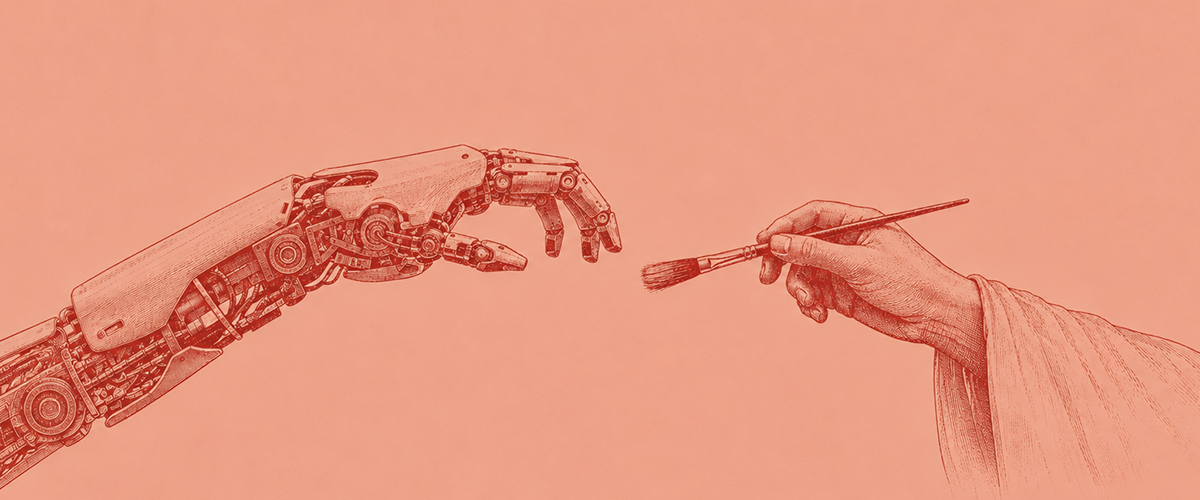
For three years, the industry narrative was ‘AI will do it faster.’ In 2026, the smartest brands are quietly proving that faster isn’t the point. Hermès commissioned Paris-based illustrator Linda Merad to hand-draw the illustrations for its website redesign, navigation, transitions, product pages, all of it. We were among the first movers to adopt AI, but we were always cautious about the world’s bet on the incoming irrelevance of human insight.
Merad has been explicit about the intent: she wants people to feel that ‘a human made this.’ Dior went further, commissioning Mumbai-based artist Rithika Merchant to hand-paint nine works for its Spring/Summer couture show, which artisans at the Chanakya School of Craft then translated into large-scale embroidered tapestries. A process reportedly involving hundreds of artisans and well over 100,000 hours of hand-stitching. Loewe commissioned illustrator Ignasi for its perfume Instagram account.
None of this was cheaper or faster than a prompt. That was never the point.
The data explains why they’re doing it. Consumer excitement about AI has reportedly fallen sharply, and mentions of ‘AI slop’ have surged, with the overwhelming majority carrying negative sentiment — I’d treat the exact figures as directional rather than precise, and recommend verifying them before quoting in a pitch.
Separately, industry research (via Harris Poll / Marketing Brew) found a majority of consumers say they’re tired of hearing about AI, and roughly two-thirds said they’d welcome brands never mentioning ‘meaningless AI marketing’ again.
A widely cited Gartner survey also suggests around half of US consumers would rather give their business to brands that avoid generative AI in customer-facing content again, worth confirming the methodology before treating it as gospel. But the direction is consistent across multiple independent studies.
That consistency is the real signal. When perfection becomes infinite and free, it stops being a marker of value. The wobble in a hand-drawn line, the visible hours in an embroidered tapestry -these have become the new scarcity. Not because craft is nostalgic, but because it’s now the only thing that can’t be generated off the shelf.
This is the opening for agencies built on craft in the first place. Not ‘AI vs. human’ as a binary — Hermès and Dior aren’t rejecting technology; they’re rejecting sameness.
The brands winning right now are the ones with the taste to know when a human hand is the strategy, not just the execution.
That’s the work we’ve always done. The market is simply catching up to ‘why’ it matters.